

When 5G FWA first came out, a lot of the hype was based on lab tests and super-fast speeds. But once these systems got out into the real world, operators found out that what really mattered was how they acted in actual use, not just what the spec sheet said.
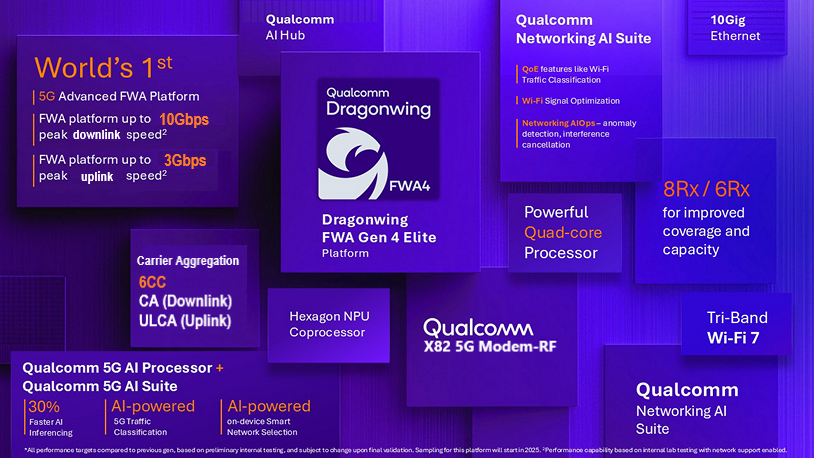
The Qualcomm X82 platform has proven itself across different regions and network setups. It's not about hitting crazy fast numbers, but about giving a reliable and steady performance when it's used in the field. We at SUNCOMM have been testing this thing on-site and these are the things that X82 gets right, and why it’s a good base for FWA CPE that people actually use.
One of the biggest things we’ve learned is that it’s better to have consistent performance than just peak speeds.
In real networks:
The amount of traffic on a cell changes.
Interference fluctuates all day.
The network gets strained during busy times.
Our data shows that CPEs using the X82 keep a more stable speed even when the network isn't at its best. Devices that are all about peak speed tend to slow down a lot more when things get congested.
SUNCOMM Insight:
During our tests, X82 CPEs didn't have as many sudden drops in speed, so users had a smoother experience, mostly in the evenings when everyone's online.
Most FWA systems use Sub-6 GHz mid-band spectrum like n41, n77, and n78. The X82 is really good in these bands:
It keeps carrier aggregation stable even with a moderate signal.
It schedules uploads reliably.
It handles congestion well.
Our tests show that X82 is at its best in the same frequency ranges where operators are deploying FWA, not just when the signal is perfect.

We’ve consistently seen that upload performance is key to having a stable connection.
We noticed that X82-based CPEs with a good upload design:
Hold onto CA configurations longer.
Don’t reset as often.
Get back up to speed faster after a temporary interference.
In our tests, devices that were focused on download speeds but had weak uploads had more lag and disconnects.
That's why we believe that a good upload speed isn't just a nice-to-have, it’s essential.
Unlike lab tests that only last a short time, FWA devices run all the time, often in hot places.
The Qualcomm X82 is built to be efficient, which means:
It uses less power.
It doesn’t get as hot.
Its radio frequency output is more consistent.
We take this even further by using heat-spreading enclosures and firmware-based thermal control. In long stress tests, X82-based CPEs didn’t slow down as much as platforms that use more power.
Interference is a fact of life:
Neighboring cells can cause it.
There can be unplanned spectrum overlap.
Users might put the device in a bad spot.
Our testing showed that X82-based devices recover from interference better. Instead of slowing down for a long time, the modem quickly re-establishes a stable connection.
This is really important in suburban and rural FWA, where cells overlap and signals bounce around a lot.
The biggest takeaway that we got from field deployments is that it's not enough to just have a powerful chip.
Our method combines:
Hardware that puts radio frequency performance first.
Antenna tuning specific to the market.
Power management that takes heat into account.
Firmware adjustments for live networks.
By treating the X82 as a base to build on, we consistently get better real-world performance than standard setups.

Operators have given us consistent feedback on our X82-based CPEs:
Fewer support tickets about performance issues.
Better stability during peak hours.
Happier users compared to older devices.
These results back up our main point: the X82 platform works well with how operator networks actually behave.
Putting these systems in real-world situations gets rid of the marketing fluff and shows what's actually important. From what we've seen, the Qualcomm X82 is successful because it focuses on the core things:
Consistent performance.
Good mid-band behavior.
Reliable uploads.
Efficient cooling.
Predictable operation under load.
When you add in smart system design and adjustments based on field data, the X82 is a ready-to-go platform for mainstream FWA.
If you’re an operator or partner looking for long-term reliability rather than just impressive benchmark numbers, the real-world lessons are clear: Qualcomm X82 does the right things and does them well.