
When evaluating a 5G outdoor router, many buyers focus on maximum download speeds. However, in real-world deployments, signal quality often has a greater impact on network performance than the advertised speed of the modem itself.
A router installed at a construction site, remote monitoring station, rural property, or smart city infrastructure project may operate miles away from the nearest cellular tower. In these scenarios, stable signal reception becomes the foundation of reliable connectivity.
4x4 MIMO and high-gain antennas are wireless technologies designed to improve signal reception, increase network capacity, and enhance overall communication performance in challenging environments.
For industrial and outdoor networking applications, these technologies can significantly improve throughput, reduce latency, and maintain stable connections even in weak-signal areas. Understanding how they work can help businesses choose the right equipment for long-term network reliability.
Many networking specifications emphasize theoretical speeds such as 2Gbps, 4Gbps, or even higher. While these figures are important, they represent ideal laboratory conditions.
In practice, network performance is affected by several factors:
Distance from the cellular tower
Physical obstacles such as buildings and trees
Weather conditions
Network congestion
Signal interference
A router capable of multi-gigabit speeds cannot achieve those speeds if it receives a weak or unstable cellular signal.
According to the International Telecommunication Union (ITU), signal quality directly influences spectral efficiency, throughput, and overall network performance. In many outdoor deployments, improving signal reception delivers greater performance gains than upgrading modem specifications alone.
This is why industrial networking equipment increasingly combines advanced modem platforms with technologies such as 4x4 MIMO and high-gain antennas.
MIMO stands for Multiple Input Multiple Output, a wireless communication technology that uses multiple antennas to transmit and receive data simultaneously.
Traditional wireless devices often use 2x2 MIMO, meaning two transmitting antennas and two receiving antennas.
A 4x4 MIMO system doubles that capability by using:
Four transmitting antennas
Four receiving antennas
Multiple simultaneous data streams
Enhanced signal diversity
This allows more information to travel between the cellular tower and the router at the same time.
In modern 5G networks, MIMO is a fundamental technology. The 3rd Generation Partnership Project (3GPP), which develops global mobile communication standards, identifies advanced MIMO systems as one of the key technologies enabling higher 5G network capacity.
For outdoor deployments, 4x4 MIMO offers several practical advantages:
Improved signal stability
Better network performance in congested areas
Higher throughput potential
Increased coverage efficiency
These benefits become especially valuable in locations where network conditions are less than ideal.
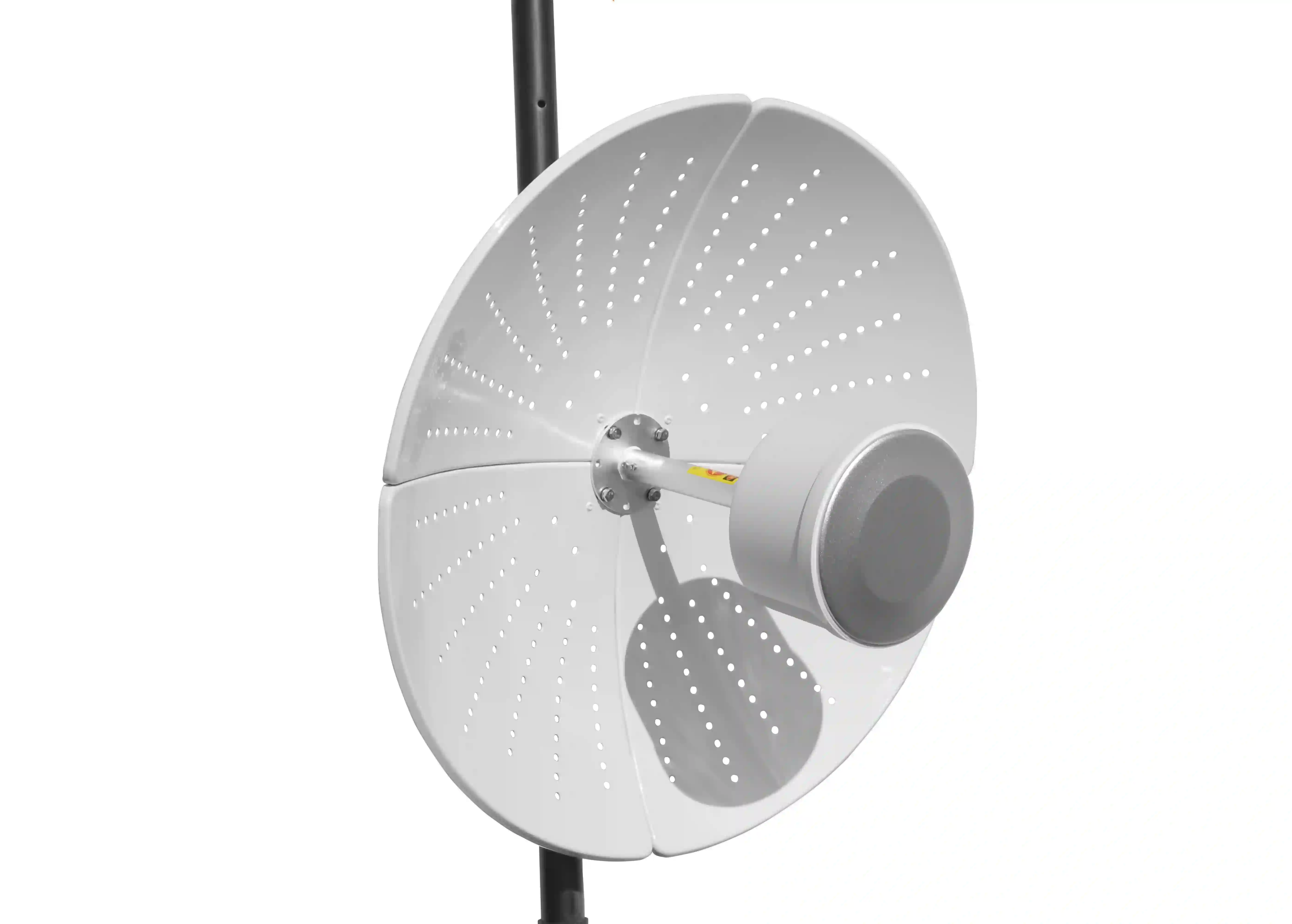
An antenna's primary function is to transmit and receive radio signals. However, not all antennas perform equally. High-gain antennas are designed to focus radio frequency energy more effectively, allowing devices to communicate over longer distances and maintain stronger connections.
In simple terms, antenna gain measures how efficiently an antenna directs signal energy. Gain is typically expressed in decibels relative to an isotropic radiator (dBi).
Benefits of high-gain antennas include:
Stronger signal reception
Extended coverage range
Improved resistance to interference
Better performance in remote areas
Many industrial-grade outdoor routers utilize antennas ranging from 6dBi to 11dBi or higher to maximize cellular signal acquisition. This becomes particularly important in rural areas, construction zones, and industrial sites where cellular towers may be located farther away than in urban environments.
Unlike indoor networking equipment, outdoor routers are often mounted on rooftops, poles, or elevated structures where high-gain antennas can fully utilize their coverage advantages.
The difference between 2x2 and 4x4 MIMO can have a significant impact on network performance, especially under challenging conditions.
| Feature | 2x2 MIMO | 4x4 MIMO |
|---|---|---|
| Antenna Configuration | 2 Transmit / 2 Receive | 4 Transmit / 4 Receive |
| Data Streams | 2 | 4 |
| Network Capacity | Standard | Higher |
| Signal Reliability | Good | Better |
| Coverage Performance | Moderate | Enhanced |
| Performance in Congested Areas | Limited | Stronger |
| Suitability for Industrial Deployments | Basic | Recommended |
While both technologies can support 5G connectivity, 4x4 MIMO provides greater resilience in environments where signal quality fluctuates.
For organizations relying on continuous connectivity, the additional antenna paths can help maintain more stable communication links.
Not every deployment requires advanced antenna systems. However, certain environments benefit significantly from enhanced signal reception capabilities.
Rural locations often have fewer cellular towers and larger coverage areas. A router equipped with 4x4 MIMO and high-gain antennas can help improve signal quality and maintain stable connectivity where standard equipment may struggle.
Construction projects frequently operate in temporary locations with limited infrastructure.
Reliable wireless connectivity is essential for:
Site management
Surveillance systems
Equipment tracking
Workforce communication
Enhanced antenna performance helps maintain connectivity throughout the project lifecycle.
Smart city applications depend on reliable communication between distributed devices.
Examples include:
Traffic monitoring systems
Environmental sensors
Public safety networks
Intelligent transportation systems
Because many devices are deployed outdoors, signal reliability becomes critical.
Industries such as mining, utilities, agriculture, and renewable energy often operate in remote environments. In these locations, strong cellular reception helps ensure uninterrupted data transmission between field equipment and centralized management platforms.
Signal performance should be one of the primary considerations when selecting an outdoor networking solution.
Key features to evaluate include:
Modern 5G chipsets deliver improved carrier aggregation, network compatibility, and signal processing capabilities.
Examples include:
Qualcomm SDX62
Qualcomm SDX75
These platforms are commonly used in industrial networking equipment designed for demanding applications.
A true industrial-grade router should support 4x4 MIMO to maximize throughput and signal stability.
Look for outdoor networking devices equipped with optimized antenna systems capable of supporting long-range communication.
These advanced features allow users to manually select specific cellular bands or towers, helping improve network stability in complex radio environments.
Reliable signal reception is only valuable if the equipment can survive harsh conditions.
Important features include:
IP65 or IP67 protection
Wide operating temperature ranges
Waterproof and dustproof enclosures
Industrial-grade hardware design
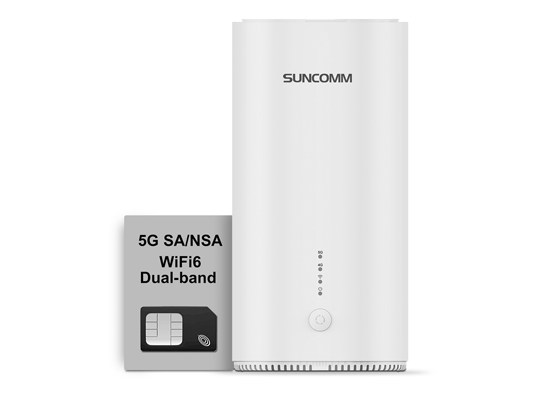
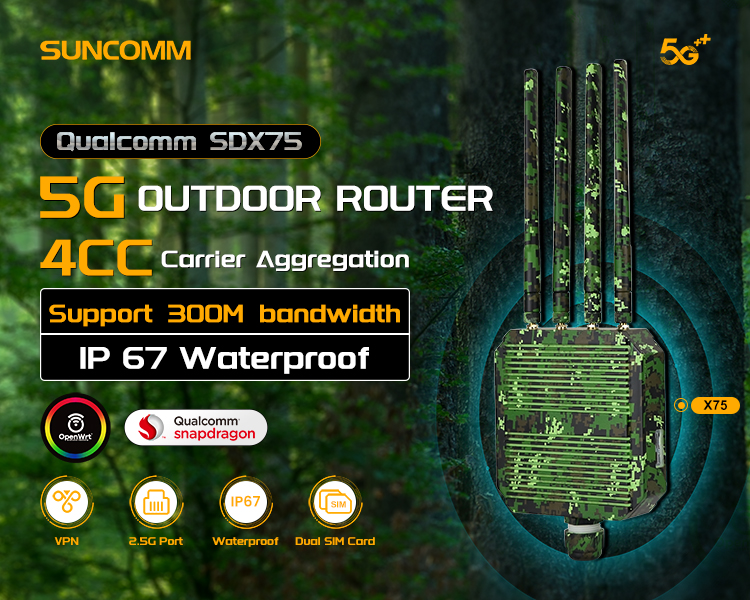
For organizations seeking reliable connectivity in demanding environments, a suncomm 5g router combines industrial durability, 4x4 MIMO technology, and high-gain antenna systems to support stable outdoor communications.
Similarly, an industrial 5g cpe modem designed for outdoor deployment can help maximize cellular network performance while supporting long-term operational reliability.
In outdoor networking environments, signal quality often determines real-world performance more than theoretical speed ratings. Technologies such as 4x4 MIMO and high-gain antennas improve signal reception, increase network capacity, and enhance connectivity stability in challenging locations. Whether deployed at construction sites, remote monitoring stations, or smart city infrastructure projects, these technologies help ensure that 5G outdoor routers can deliver reliable communication when it matters most.
4x4 MIMO refers to a wireless communication system that uses four transmitting antennas and four receiving antennas to improve data transmission efficiency and signal reliability.
In most outdoor networking applications, 4x4 MIMO provides higher capacity, improved signal stability, and better performance in congested or weak-signal environments.
A high-gain antenna is designed to focus radio signals more effectively, allowing stronger signal reception and extended communication range.
Outdoor routers are often deployed far from cellular towers. High-gain antennas help improve signal quality, coverage, and overall network performance.
In many cases, improving signal quality through better antennas can increase throughput and network stability, especially in areas with weak cellular coverage.
3GPP – Mobile Communication Standards and 5G Technology
https://www.3gpp.org
International Telecommunication Union (ITU) – IMT-2020 and 5G Network Standards
https://www.itu.int
Wikipedia – Multiple-Input and Multiple-Output (MIMO)
https://en.wikipedia.org/wiki/MIMO