
When we make a phone call or watch a video online we do not think about how it all works.. There is a lot of technology behind it.
Every time we use our phone or connect to the internet it depends on a system of wireless infrastructure that is working in the background.
When we use our smartphone or connect a 5G router we usually only see that we have internet access.. Behind that connection is a very complicated system of antennas and radio units and fiber networks and software all working together in real time.
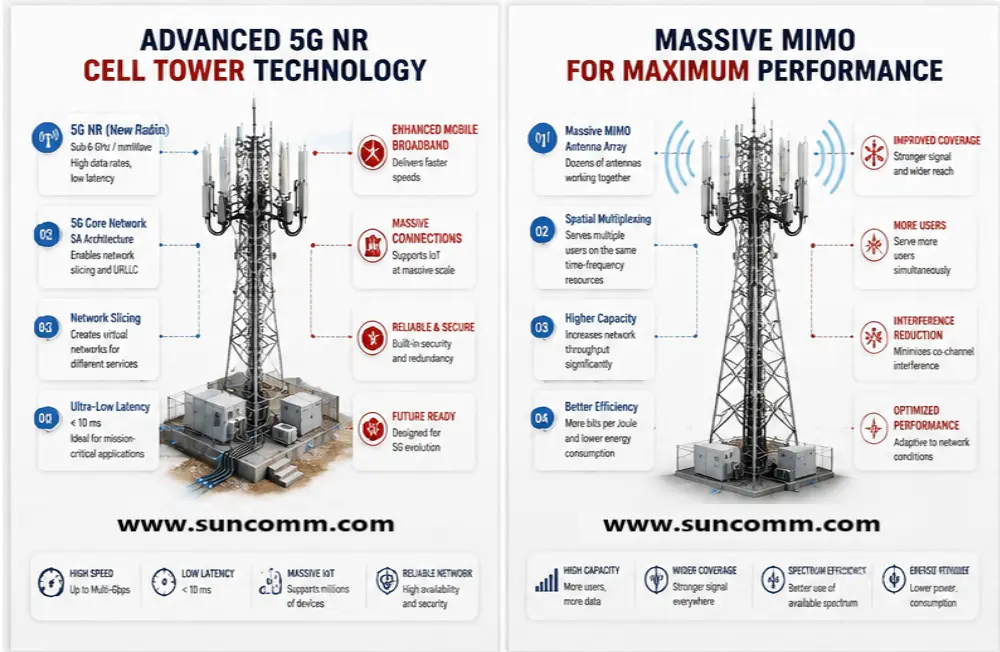
A modern cell tower is not a simple antenna on top of a building. It has become an advanced communication platform that uses many different technologies such as 5G NR and Massive MIMO and Beamforming and Carrier Aggregation and Multi-band antennas and High-speed fiber backhaul.
All these technologies work together to make our internet connections faster and more reliable.
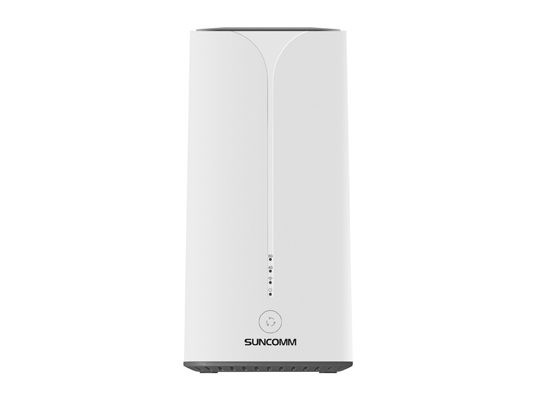
At SUNCOMM we work with technologies every day because we make 5G CPE and wireless networking solutions. Understanding how the network works helps us make devices that can communicate more efficiently with the mobile infrastructure.
A cell tower is like a bridge between our devices and the internet.
It connects our devices to the operators core network.
When we connect to the internet using a 5G router our data does not go directly to the internet. It first sends a signal to a cell tower.
Then the cell tower sends our data to the operators network through a high-speed connection.
A modern cell tower contains several important components and technologies that work together to transmit, receive, and process wireless signals.
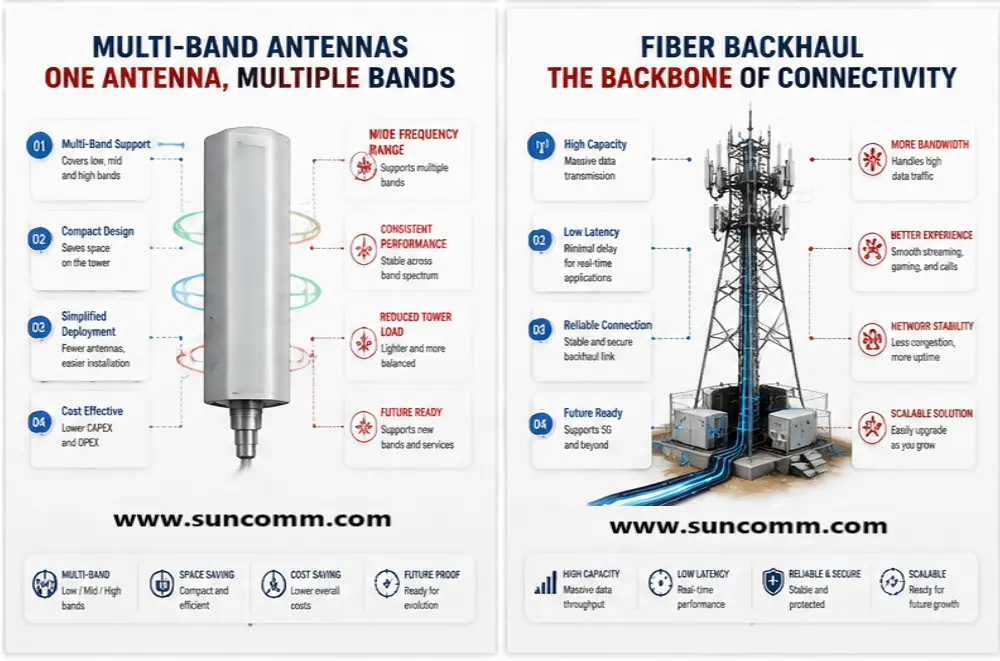
One of the visible parts of a cell tower is the antenna system.
Modern cell towers usually have antennas that operate across different frequency bands. Each frequency range offers different advantages.
Low-band spectrum is effective for covering large areas and improving signal penetration indoors. However, it usually provides lower peak speeds than higher-frequency bands.
Mid-band spectrum provides a balance between coverage and speed, making it an important frequency range for many 5G networks.
High-band spectrum, also known as mmWave, can provide very high speeds. However, it does not cover as wide an area and can be blocked more easily by walls, buildings, and other obstacles.
Behind the antennas are radio units that send and receive signals.
Their main job is to convert signals into radio signals and amplify the transmission power and receive signals from our devices.
In 5G networks radio units are often integrated directly with the antenna system.
This design is more efficient. Improves signal control and beamforming capability.
One of the changes from 4G to 5G is the introduction of Massive MIMO.
Traditional systems use an antennas but 5G base stations can use dozens or even hundreds of antennas.
Massive MIMO allows the base station to communicate with users at the same time.
This technology is very important in areas such as stadiums and airports and city centers.
In wireless systems signals spread out in all directions.
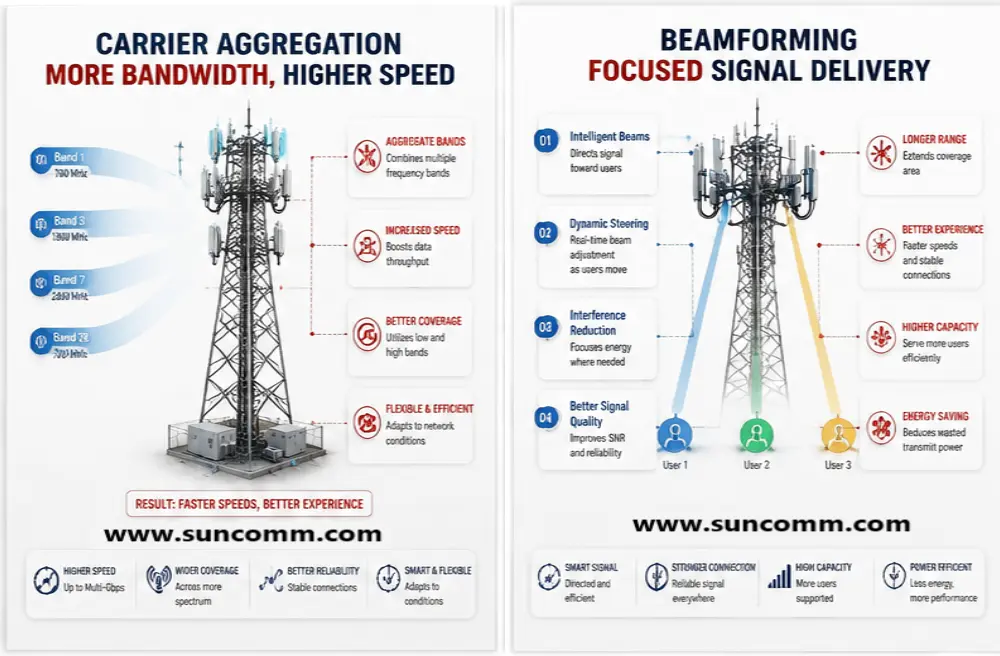
5G introduces advanced beamforming technology that can create focused signal paths toward specific users.
This technology improves quality and reduces interference and provides a better user experience.
Mobile operators usually do not have one block of spectrum.
Instead they have smaller frequency resources.
Carrier Aggregation allows the network to combine these carriers into one faster connection.
This technology improves download speed and upload performance and network efficiency.
The baseband unit is like the brain of the cell tower.
It processes communication signals. Handles user connections and data scheduling and network management.
In networks baseband functions are increasingly virtualized.
This allows operators to manage network resources flexibly.
A cell tower needs a high-speed connection to transport all user data.
This connection is called backhaul.
Most modern cell towers use fiber optic connections.
Fiber provides high bandwidth and low latency and reliable transport.
| Technology or component | Main function | Network benefit |
| Multi-band antennas | Transmit and receive signals across different frequency bands | Balance coverage, indoor penetration, and network capacity |
| Remote radio units | Convert, amplify, transmit, and receive radio signals | Improve radio efficiency and signal processing |
| Massive MIMO | Use multiple antenna elements to serve several users | Increase capacity in high-density areas |
| Beamforming | Direct signals toward specific users | Improve signal quality and reduce interference |
| Carrier Aggregation | Combine multiple frequency carriers | Increase bandwidth and connection speed |
| Baseband processing | Manage signals, scheduling, and user connections | Coordinate network resources in real time |
| Fiber backhaul | Transport data between the tower and core network | Provide high bandwidth and low latency |
When a 5g cpe device or router connects to the network, it searches for available cellular signals.
Then it selects the available cell based on signal strength and signal quality and network configuration.
After that it establishes a connection using technologies such as 5G NR and LTE fallback and Carrier Aggregation.
Finally it sends data through the tower and backhaul network and core network.
All of this happens quickly in just a few milliseconds.
For a 5g router supplier or a company that manufactures fixed wireless access devices, understanding cell tower technology is very important.
A high-performance 5G router must work efficiently with different mobile network configurations.
Important device features include modem capability, high-quality antenna design, thermal optimization, and software optimization.
The router must also support the correct frequency bands and network technologies used by the target mobile operator.
Cellular infrastructure is always changing.
Future networks will introduce intelligent AI-based optimization and higher-order carrier aggregation and better energy efficiency and improved uplink capability and advanced MIMO technologies.
With the development of 5G-Advanced cell towers will become smarter and more efficient and better prepared for applications such as smart cities and industrial IoT and autonomous systems and edge computing.
A cell tower connects smartphones, routers, and IoT devices to a mobile operator’s network. It receives wireless signals from connected devices and transports their data through the backhaul and core network.
In many cases, 4G LTE and 5G equipment can be installed at the same cell site. Mobile operators may upgrade existing towers with new antennas, radio units, and baseband equipment to support 5G.
A 5G router searches for compatible cellular signals and selects an available cell based on signal strength, signal quality, supported frequency bands, and the operator’s network configuration.
Strong signal strength does not always guarantee high speed. Network congestion, interference, unsupported Carrier Aggregation combinations, router hardware, and backhaul capacity can all affect performance.
Many modern cell towers use fiber because it provides high bandwidth and low latency. However, microwave links and other backhaul technologies may be used where fiber is unavailable.
A modern cell tower is not a simple antenna.
It is an integrated communication system that combines advanced antennas and radio technology and Massive MIMO and Beamforming and Carrier Aggregation and fiber backhaul and intelligent software.
Every time we connect our phone or a 5G router or an IoT device thousands of technologies work together behind the scenes.
At SUNCOMM we believe that understanding the wireless ecosystem is essential, for building better 5G CPE solutions.
The future of connectivity will depend on how every part of the system works together.