
As 5G networks continue to expand worldwide, more users are considering 5G CPE routers as an alternative to traditional broadband services. Whether for home internet, remote work, small offices, or temporary deployments, a 5G CPE router can provide fast and flexible connectivity without relying on fiber or cable infrastructure.
However, not all 5G routers offer the same capabilities. While many products advertise impressive speed figures, factors such as chipset performance, Wi-Fi technology, Ethernet interfaces, signal optimization features, and network management tools often have a greater impact on real-world user experience.
A 5G CPE router is a device that converts a cellular 5G connection into wired and wireless internet access for homes, offices, and remote locations.
If you're planning to invest in a new 5G router in 2026, here are six key features worth evaluating before making a decision.
The performance of a 5G router affects much more than download speed. It can influence:
Network stability during peak hours
Coverage throughout a home or office
Support for multiple connected devices
Long-term compatibility with future network upgrades
Overall return on investment
A router designed with modern hardware and advanced network management capabilities can continue delivering reliable service for years, even as connectivity demands increase.
The modem platform is the foundation of any 5G CPE router. It determines network compatibility, speed potential, carrier aggregation capabilities, and future support for evolving 5G standards.
One of the newest platforms available today is Qualcomm's SDX75, which supports 3GPP Release 17 and delivers theoretical download speeds of up to 6Gbps and upload speeds of up to 0.9Gbps.
Release 17 introduces enhancements for network efficiency, coverage, and device performance, helping routers remain compatible with the latest operator deployments.
When comparing products, look for routers built on modern platforms rather than older-generation chipsets. A newer platform often provides:
Better network efficiency
Improved carrier aggregation
Enhanced signal processing
Longer product lifespan
For users planning to keep their router for several years, chipset selection is one of the most important purchasing considerations.
Many users focus exclusively on cellular performance, but the Wi-Fi experience inside the home or office is equally important.
A fast 5G connection can quickly become limited if the wireless network cannot distribute bandwidth efficiently to connected devices.
Wi-Fi 7 is the latest generation of wireless networking technology and offers improvements over previous standards in areas such as:
Higher throughput
Lower latency
Better multi-device performance
Improved spectrum efficiency
According to the SDX75 specification, the router supports Wi-Fi 7 technology with dual-band operation and wireless speeds reaching up to 7.2Gbps under supported configurations.
For households and offices with dozens of connected devices, Wi-Fi 7 helps ensure smoother performance for:
Video conferencing
Online gaming
Cloud applications
4K and 8K streaming
Smart home devices
Choosing Wi-Fi 7 today can also help future-proof a network as device requirements continue to grow.
Wireless connectivity is important, but wired networking remains essential for many users.
Devices such as:
Desktop PCs
NAS storage systems
Security cameras
Business servers
Gaming consoles
often perform best when connected via Ethernet.
Unfortunately, some routers still rely solely on traditional Gigabit Ethernet ports, which can become a bottleneck as broadband speeds increase.
| Ethernet Port Type | Maximum Speed |
|---|---|
| Fast Ethernet | 100 Mbps |
| Gigabit Ethernet | 1 Gbps |
| 2.5G Ethernet | 2.5 Gbps |
| 10G Ethernet | 10 Gbps |
The SUNCOMM SDX75 5G CPE Router offers a 2.5G WAN/LAN port alongside a Gigabit LAN interface, providing greater flexibility for high-speed networking environments. A 2.5G port can help ensure that local wired connections are capable of taking advantage of future broadband upgrades.
Raw signal strength is only one part of the connectivity equation. How a router manages cellular connections can significantly impact stability and user experience.Modern 5G routers increasingly offer advanced tools such as:
Band Lock
Cell Lock
Network selection controls
These features allow users to maintain connections to preferred frequency bands or specific cellular towers.Benefits include:
Reduced signal fluctuations
Improved connection consistency
Better performance in congested areas
Greater control over network behavior
For users living near multiple cellular towers, these tools can often make a noticeable difference in everyday performance.
Even the most advanced modem cannot perform optimally if signal conditions are poor. This is why antenna flexibility remains a critical feature when evaluating a 5G router.
External antenna support can be particularly valuable in:
Rural locations
Large homes
Small offices
Metal buildings
Areas with weak cellular coverage
The SDX75 includes six LTE/NR antennas and provides two TS9 connectors for optional external antenna connections.
External antennas can help improve:
Signal strength
Coverage range
Download speeds
Upload speeds
Network stability
For users located farther from cellular towers, antenna support can be one of the most valuable features available.
A modern router should do more than provide internet access. It should also offer tools for network security and advanced configuration.
Important capabilities include:
VPN support
IP Passthrough
AT Command support
Firewall functionality
Remote management options
These features allow users to customize their networking environment while improving privacy and security.
For business users, VPN functionality can help protect sensitive traffic. IP Passthrough can simplify integration with third-party networking equipment, while advanced configuration options provide greater flexibility for specialized deployments. As networking requirements become more sophisticated, these capabilities are increasingly important for both residential and professional users.
A useful way to evaluate a router is to compare it against the features discussed above.
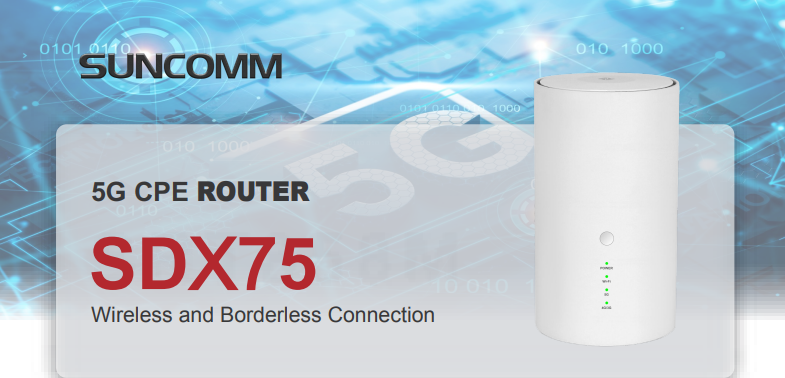
For example, the SUNCOMM SDX75 5G CPE Router combines several modern technologies in a single device, including:
Qualcomm sdx75 platform
3GPP Release 17 support
Wi-Fi 7 connectivity
2.5G Ethernet interface
RJ11 voice support
Band Lock and Cell Lock
VPN functionality
IP Passthrough
External antenna support
According to the product specification, the device supports download speeds of up to 6Gbps, dual-band Wi-Fi operation, and advanced signal optimization capabilities designed for home and small-office environments. Rather than focusing on a single specification, users should evaluate how these features work together to support long-term network performance.
Choosing the right 5g cpe device involves much more than comparing speed ratings. A modern platform, Wi-Fi 7 support, high-speed Ethernet ports, advanced signal management tools, external antenna compatibility, and robust security features all contribute to a better user experience. By evaluating these six key areas, buyers can select a router that delivers reliable performance today while remaining ready for future connectivity demands.
A 5G CPE router is a device that receives a cellular 5G signal and converts it into wired and wireless internet access for homes, offices, and other locations.
It depends on local network availability. In areas where fiber is unavailable or difficult to install, a 5G CPE router can provide a flexible and high-speed alternative.
Wi-Fi 7 improves local wireless performance by supporting higher speeds, lower latency, and better handling of multiple connected devices.
Band Lock allows a router to remain connected to a preferred cellular frequency band instead of automatically switching between bands.
External antennas can improve signal reception and network stability in locations where cellular coverage is weak or obstructed.
3GPP – Release 17 Mobile Communication Standards
https://www.3gpp.org
Wikipedia – Customer-premises Equipment (CPE)
https://en.wikipedia.org/wiki/Customer-premises_equipment
Wi-Fi Alliance – Wi-Fi CERTIFIED 7 Overview
https://www.wi-fi.org