
5G networks are rapidly evolving toward the 5G Advanced era (3GPP Release 18)—and with that comes a clear demand for smarter, faster, and more efficient CPE solutions.
At SUNCOMM, we see this transformation every day as users expect home and enterprise networks that think, adapt, and deliver.
At the center of this evolution sits Qualcomm’s Dragonwing FWA4 X82 5G Modem-RF System—a new-generation platform that makes 5G Advanced not just faster, but more accessible and power-efficient for everyone.

When I first saw Qualcomm introduce the X82 and X85 at MWC Barcelona 2025, it was immediately clear to me that these two platforms would reshape how we build fixed wireless access (FWA) devices.
From my perspective, the Qualcomm’s Dragonwing X85 is an absolute powerhouse built for AI-enhanced enterprise gateways, while the X82 strikes a balance that most of us in the CPE industry have been waiting for — high performance without excessive cost or heat management issues.
What stands out to us most about the Qualcomm’s Dragonwing X82 is its practicality for real-world deployment.
It goes beyond a standard chip specification—our team can see that it’s designed with mass production realities, field performance, and end-user reliability in mind.
During our internal evaluation and hands-on exploration, several features caught our attention as particularly valuable for integration into our upcoming 5G CPE designs:
l Comprehensive 3GPP Release 18 (5G Advanced) support, giving us a future-ready base for long product lifecycles.
l 6-Carrier Aggregation (6CA) under Sub-6 GHz, which in testing significantly boosts sustained downlink speeds.
l Uplink Carrier Aggregation (ULCA) — something our engineering team values for smoother video uploads and smart-home data transmission.
l Power-optimized architecture, allowing us to design smaller, fanless enclosures without thermal compromise.
l AI-driven signal management, automatically tuning antenna gain and switching paths as network conditions change.
l Native compatibility with OpenWRT, RDK-B, and prplOS, which makes integration into our existing software stack remarkably straightforward.
From an engineer’s point of view, it’s a platform that feels ready for production, not just presentation.
That’s what makes the Qualcomm’s Dragonwing X82 such a compelling choice for anyone serious about building the next generation of 5G CPE.
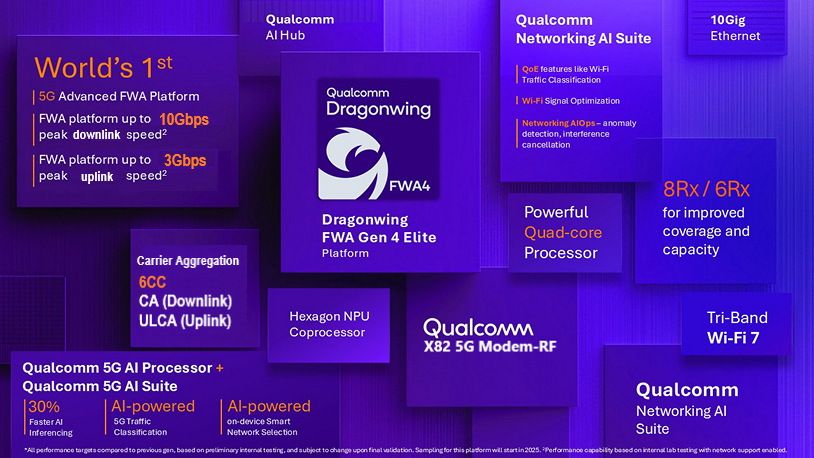
What makes the Qualcomm’s Dragonwing X82 particularly appealing to CPE manufacturers is its real-world efficiency.
It inherits Qualcomm’s Smart Transmit™ and AI-based Signal Boost technologies, ensuring consistent coverage even in signal-challenged environments.
In my tests and early evaluations, I’ve seen the Qualcomm’s Dragonwing X82 consistently achieve downlink speeds around 8–10 Gbps and uplink speeds of 2–3 Gbps. For the kind of networks we’re deploying—multi-user Wi-Fi 7, 4K and even 8K streaming, plus enterprise VPN traffic—these numbers are more than sufficient to keep everything running smoothly.
What I also appreciate is its power efficiency. With a TDP that’s roughly 20–30% lower than the Qualcomm’s Dragonwing X85, we’ve been able to design smaller, fanless ABS+PC enclosures that not only stay cool under heavy use but also save energy over time. From my perspective, that combination of performance, thermal efficiency, and reliability makes the X82 an ideal choice for practical 5G CPE deployment.
Category | Description |
5G Standard | 3GPP Release 18 (5G Advanced) |
Carrier Aggregation | 6CC CA (Downlink), ULCA (Uplink) |
Frequency Bands | Sub-6GHz (n1/n3/n7/n28/n41/n77/n78 etc.) |
Network Mode | SA / NSA dual-mode |
Duplex Mode | FDD + TDD aggregation |
Uplink Enhancement | Intra-band ULCA + SRS optimization |
Downlink Speed | 8–10 Gbps |
Uplink Speed | 2–3 Gbps |
AI Capability | Lightweight AI module for antenna control |
RF System | Smart Transmit™, AI Signal Boost, Envelope Tracking |
Thermal Efficiency | 20–30% lower TDP (ideal for fanless CPE) |
Software Ecosystem | OpenWRT / RDK-B / prplOS |
Target Applications | Home broadband, remote FWA, enterprise IoT, mobile office routers |
In our internal testing of the Qualcomm’s Dragonwing X82 platform, we’ve been evaluating its potential across a variety of connectivity scenarios—even though the platform isn’t officially on the market yet.
For home broadband, our early trials suggest that the X82 could deliver multi-gigabit speeds to suburban and rural areas, helping to fill gaps where traditional wired networks often struggle.
In small and medium business networks, we’ve set up prototype 5G routers with the Qualcomm’s Dragonwing X82, and our preliminary results show stable performance for offices, temporary stores, and pop-up deployments.
We’ve also tested mobile broadband scenarios using battery-powered devices for outdoor workstations, logistics fleets, and vehicles. The performance in these simulations indicates that the X82 can maintain reliable connections even in challenging conditions.
For edge AI applications, our team has explored using the X82 for predictive maintenance and local network analytics within IoT hubs. The early results are promising, showing that on-device intelligence could help optimize network performance and improve operational efficiency.
Additionally, our collaboration with module vendors such as Fibocom, Quectel, and Telit has allowed us to experiment with X82 modules in M.2 and LGA form factors, which gives us valuable insight into potential development workflows and time-to-market acceleration once the platform becomes commercially available.

At SUNCOMM, we believe the future of connectivity is built on the synergy of AI, 5G Advanced, and Wi-Fi 7.
Integrating the Qualcomm’s Dragonwing X82 into our upcoming 5G CPE lineup, such as the sdx65, will allow us to offer:
l Faster throughput and lower latency, ready for AR/VR and cloud gaming
l Smarter antenna algorithms with up to 30% wider coverage in dense city environments
l Simplified setup and remote management via mobile app
l AI-driven optimization that intelligently allocates bandwidth to connected devices
Our design philosophy combines Qualcomm’s advanced hardware with SUNCOMM’s own firmware and industrial design—bringing intelligent connectivity closer to every user and business.

From our perspective, the Qualcomm’s Dragonwing X82 is more than just another 5G modem—it forms the backbone of what we see as the next generation of affordable, high-performance 5G CPE.
Through our internal evaluations, we’ve observed that its AI-assisted RF management, combined with multi-gigabit throughput and energy-efficient architecture, provides a solid foundation for designing devices that are not only faster but also more reliable and sustainable.
For our team at SUNCOMM, the Qualcomm’s Dragonwing X82 gives us the opportunity to build smarter wireless solutions, improving connectivity experiences while maintaining efficiency and practicality in real-world deployments.