

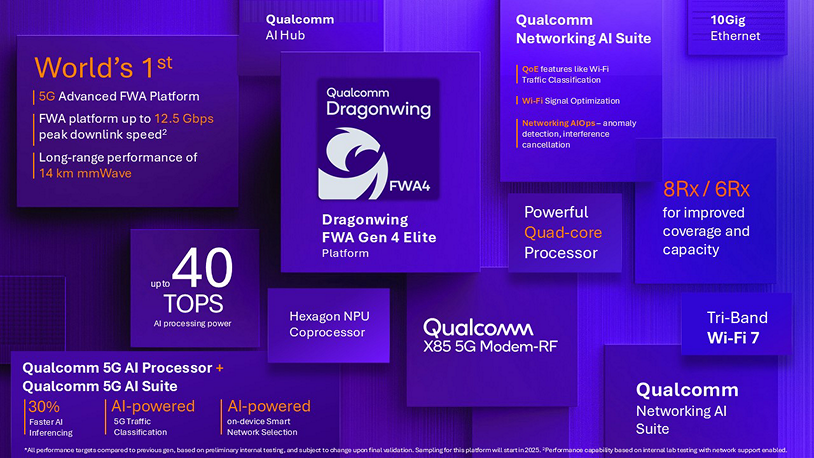
When Qualcomm introduced the X85 platform with built-in edge AI computing, many people focused on one number: TOPS.
40 TOPS sounds impressive — but for most customers and even many engineers, the real question is simpler:
What does this AI computing power actually do inside a 5G CPE?
To answer that, we need to look beyond raw performance and understand how edge AI changes the behavior of network devices in real-world environments.
A common misunderstanding is that edge AI in a 5G CPE is meant to run large language models or user-facing AI applications directly on the device.
In reality, the value of edge AI on platforms like Qualcomm X85 lies in making the network itself smarter, faster, and more adaptive.
This AI power is primarily used for:
Real-time signal analysis
Network behavior prediction
Dynamic optimization under changing conditions
These tasks must be executed locally, within milliseconds, and without relying on the cloud.
Before edge AI, most CPE optimization relied on static rules and thresholds:
Fixed antenna selection logic
Predefined QoS priorities
Manual band-locking or carrier preference
These methods work in controlled environments but struggle in real deployments where:
Radio conditions change constantly
User behavior is unpredictable
Interference patterns are non-linear
Rule-based systems react after problems appear. AI-driven systems can begin to anticipate them.

One of the most practical applications of edge AI on Qualcomm X85 is radio-layer intelligence.
By continuously analyzing:
SINR and RSRP trends
Interference patterns
Uplink and downlink imbalance
The AI engine can assist the modem in making faster and more precise decisions, such as:
Selecting optimal carrier combinations
Adjusting antenna paths dynamically
Balancing throughput and stability instead of chasing peak speed
This results in more consistent performance, especially in dense or unstable network environments.
Uplink performance is often the limiting factor for real-world applications such as:
Video conferencing
Cloud uploads
Remote monitoring
Edge data aggregation
Edge AI enables the device to:
Detect uplink congestion early
Adjust scheduling behavior proactively
Preserve voice and real-time traffic quality under load
This is particularly important for enterprise-grade CPE, where reliability matters more than benchmark numbers.

Beyond radio optimization, AI computing allows the CPE to understand what kind of traffic is flowing through the network.
Instead of relying solely on port-based or protocol-based classification, AI-assisted traffic analysis can:
Identify latency-sensitive applications
Detect abnormal traffic patterns
Support more granular QoS enforcement
This makes the CPE better suited for mixed workloads, where cloud apps, voice, video, and IoT traffic coexist.
One of the key advantages of edge AI is that decisions are made locally.
This means:
No round-trip delay to cloud servers
No dependency on external connectivity for optimization
Better privacy for sensitive network data
In mission-critical or enterprise scenarios, local intelligence is not just a performance feature — it is a reliability requirement.
.jpg "qualcomm-dragonwing_(1).jpg")
The edge AI capability of Qualcomm X85 is not designed for entry-level or cost-sensitive devices.
It makes sense in scenarios such as:
Enterprise-grade AI CPE
Industrial FWA deployments
Multi-user, high-density environments
Edge computing gateways
In these use cases, the ability to adapt in real time delivers measurable value that justifies the higher platform cost.
Perhaps the most important point is this:
Edge AI on X85 is not a standalone feature — it is a foundation.
It enables future software capabilities, smarter network behavior, and tighter integration between radio, system, and application layers.
As networks become more complex, CPE devices that can think locally will age better than those that rely purely on static logic.
Edge AI on Qualcomm X85 is not about marketing buzzwords or futuristic demos.
Its real value lies in making 5G CPE devices more stable, adaptive, and reliable under real-world conditions.
For manufacturers building high-end FWA and enterprise CPE solutions, this kind of intelligence is no longer optional — it is what separates robust products from spec-driven designs.